

Monday Proceedings in Parliament… Parliament Shifts from Making Law to Interpreting It

By Kelvin Jay
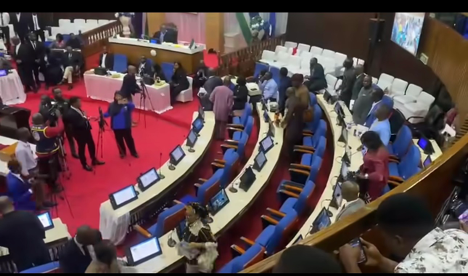
What happened during Monday’s proceedings in Parliament, particularly in the debate over the Constitutional Amendment Bill, has raised questions about whether Parliament shifted from its constitutional responsibility of making laws to interpreting the Constitution. The disagreement centred on the interpretation and application of constitutional provisions governing the amendment of the Constitution.
Submitting his views, the Opposition Leader of Parliament, Hon. Abdul Kargbo, categorically stated that Section 108 of the 1991 Constitution is an entrenched provision that specifically deals with the amendment of the Constitution. He argued that any attempt to alter the Constitution must be supported by a two-thirds majority, citing Section 108 of the 1991 Constitution to buttress his position.
Responding to the Opposition Leader, SLPP MP Hon. Hindolo Gavao challenged Kargbo’s interpretation, referring Members to Section 108(2), which states:
“A Bill for an Act of Parliament under this section shall not be passed by Parliament unless—
(a) before the first reading of the Bill in Parliament the text of the Bill is published in at least two issues of the Gazette; and
(b) the Bill is supported on the second and third readings by the votes of not less than two-thirds of the Members of Parliament.”
In his analysis, Hon. Gavao argued that Section 108(2) specifically refers to the passage of the Bill by a two-thirds majority and does not expressly state that each individual clause must be approved by the same threshold.
He maintained that Parliament was at the committee stage, where Members were voting on individual clauses rather than on the Bill as a whole. According to him, the voting at that stage was therefore guided by Section 91(1) of the 1991 Constitution, which provides:
“Except as otherwise provided in this Constitution, any question proposed for decision in Parliament shall be determined by a majority of the votes of the Members present and voting.”
Deputy Opposition Leader of Parliament, Hon. Daniel Koroma, supported Abdul Kargbo’s submission. He argued that Section 91 is a general provision and that constitutional provisions containing specific requirements must take precedence over general provisions.
Koroma criticised Hon. Gavao’s interpretation, maintaining that Section 108 constitutes an exception to Section 91(1). He pointed to other constitutional provisions as examples of exceptions to the general rule, including provisions relating to the declaration of a state of emergency.
Leader of Government Business, Hon. Mathew Nyuma, also defended the position of the ruling side, arguing that Section 91 should apply to the voting on individual clauses. He said Parliament had followed that procedure “times without number” and maintained that while Section 108 becomes applicable to the holistic passage of the Bill, the consideration of individual clauses should be governed by Section 91.
Speaker of Parliament, Hon. Segepoh Solomon Thomas, took time to explain his ruling. He urged Members to turn to Section 91(1) of the 1991 Constitution, which he described as a provision written in plain language rather than legalese.
After reading the provision, the Speaker endorsed the position of the ruling side and made reference to other constitutional provisions, including Sections 29, 119(9) and 137, in an effort to provide further justification for his ruling.
He maintained that, except where the Constitution provides otherwise, decisions before Parliament must be determined by a majority of Members present and voting.
The Speaker further argued that the two-thirds threshold under Section 108 would come into play at the stage of the third reading of the Bill. He stressed that consideration of individual clauses during the committee stage does not, in itself, amount to the enactment of the law.
He also referred to the Search and Nomination Committee, arguing that the committee itself is not established by the Constitution of Sierra Leone, and ultimately ruled that voting on the clauses of the Bill should be conducted by a simple majority.
Following the Speaker’s ruling, the Opposition strongly objected, declaring that its Members could not be party to any process they believed undermined the Constitution.
“I want the entire world to know that we on this side would not be a party to this amendment that lacks the threshold,” the Opposition Leader stated.
He subsequently called on his colleagues to leave the Chamber, after which APC Members walked out while singing a song associated with the struggle for victory.
Following the walkout, the Speaker referred the constitutional dispute to the Supreme Court for interpretation.
However, the Speaker’s decision has itself generated debate among legal and political observers. Questions have been raised as to whether the matter should have first been referred to the Supreme Court before the Speaker proceeded to make a definitive ruling on the disputed constitutional provision.
Some argue that, given the constitutional uncertainty surrounding the required voting threshold, the Speaker could have suspended consideration of the disputed clause and sought the Supreme Court’s interpretation before proceeding.
Critics therefore contend that making a ruling first and referring the matter to the Supreme Court afterwards risks putting “the cart before the horse,” particularly where the dispute concerns the very constitutional provision governing the validity of the parliamentary process.