

“It’s a Lie” — First Lady Fatima Bio Dismisses FGM Allegation, Questions Delay in Police Report

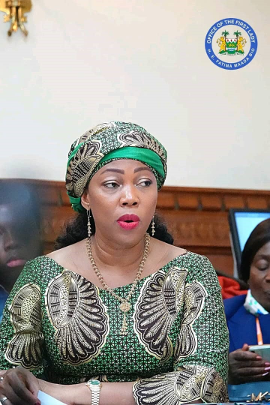
First Lady Fatima Maada Bio has strongly dismissed allegations made by a 30-year-old woman who claimed she was forcefully subjected to Female Genital Mutilation (FGM), describing the accusation as fabricated and politically motivated.
Speaking on the matter, the First Lady stated that the woman was allegedly influenced by certain individuals to concoct the story, insisting that the claims do not reflect the truth.
“It’s a lie,” Fatima Bio declared, adding that she believes the allegations were orchestrated by people seeking to advance a particular agenda.
The First Lady also expressed concern over what she described as the unexplained delay in the publication of the Police investigation report into the matter.
“I don’t even know why the Police have not published the report yet,” she said, suggesting that the findings could help clarify the circumstances surrounding the allegations and address the public debate generated by the case.
The controversy has attracted significant public attention, with discussions continuing across social media platforms and within civil society circles. Advocates on different sides of the debate have called for transparency and due process, while awaiting the official findings of law enforcement authorities.
As public interest in the matter grows, many observers are looking to the Sierra Leone Police to release the outcome of their investigation in order to provide clarity and address the competing narratives surrounding the case.
NEW Chairperson Calls for Strong Partnership with ECSL to Advance Electoral Reforms
The newly elected Chairperson of the National Elections Watch (NEW), Charles Keif Kobai, has reaffirmed the organization’s commitment to working closely with the Electoral Commission for Sierra Leone (ECSL) to promote progressive electoral reforms and strengthen the country’s democratic framework.
Speaking on the future direction of the organization, Kobai emphasized the importance of collaboration between election stakeholders to ensure that necessary amendments to Sierra Leone’s electoral laws are implemented in line with regional and international best practices.
“We will work in partnership with ECSL to lobby Parliament to pass the new electoral laws that will be in line with ECOWAS requirements,” he stated.
According to the NEW Chairperson, electoral reforms remain critical to enhancing transparency, accountability, and public confidence in the country’s democratic processes. He noted that many of the recommendations advanced by National Elections Watch have already been captured in the Tripartite Committee Report, providing a solid foundation for future legislative reforms.
Kobai explained that the organization intends to engage constructively with key institutions, including ECSL, Parliament, civil society organizations, and development partners, to ensure that the proposed amendments are translated into law before future elections.
He further stressed that aligning Sierra Leone’s electoral framework with ECOWAS standards would not only strengthen electoral credibility but also reinforce the country’s commitment to democratic governance and constitutional order.
The NEW Chairperson maintained that electoral reform should be viewed as a national priority rather than a partisan issue, noting that an effective and inclusive electoral system benefits all citizens regardless of political affiliation. He called on all stakeholders to support efforts aimed at modernizing the electoral legal framework and addressing gaps identified during previous elections.
Kobai also reaffirmed National Elections Watch’s role as an independent election observation body committed to promoting free, fair, peaceful, and credible elections. He said the organization would continue to provide evidence-based recommendations and advocate for reforms that enhance electoral integrity and public trust.
As Sierra Leone continues discussions on implementing recommendations emerging from the Tripartite process, the newly elected NEW leadership believes that stronger collaboration among electoral institutions will be essential in delivering reforms capable of strengthening democracy and ensuring future elections meet both national aspirations and regional standards.