
ECOWAS Chairmanship: Did President Faye Defeat Bio or Was It a Routine Transition?

By Kelvin Jay
The election of Senegal’s President Bassirou Diomaye Faye as the new Chairman of the ECOWAS Authority of Heads of State and Government has ignited political debate in Sierra Leone, with conflicting interpretations emerging over whether President Julius Maada Bio sought a second consecutive term and was rejected by his regional colleagues.
Ahead of the 69th ECOWAS Summit in Lungi, Sierra Leone’s Minister of Foreign Affairs and International Cooperation, Timothy Kabba, publicly expressed optimism that President Bio could continue as Chairman of the regional bloc. According to the Minister, diplomatic engagements had been undertaken with fellow Heads of State in support of President Bio’s continued leadership.
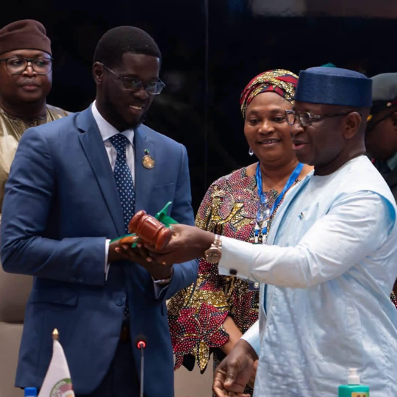
However, the outcome of the summit saw President Bassirou Diomaye Faye elected to succeed President Bio, bringing an end to the latter’s one-year tenure at the helm of ECOWAS.
The result has since fueled speculation among political commentators and analysts over what transpired behind closed doors before the consensus was reached.
Pan-African journalist Melvin Tejan Mansaray argued that the statements made by the Foreign Affairs Minister suggested there had been an effort to secure President Bio’s retention as ECOWAS Chairman.
“The indications before the summit were that President Bio wanted to continue for a second term. But the election of President Faye suggests that the regional leaders opted for a change in leadership,” Mansaray asserted.
According to him, the outcome reflected the preference of ECOWAS leaders to hand over the Chairmanship to another Head of State rather than extend President Bio’s mandate.
Critics argue that while the state-of-the-art conference centre showcased Sierra Leone’s commitment to regional integration and enhanced the country’s image, it did not influence the political calculations of ECOWAS leaders when choosing their new Chairman.
Some commentators have even questioned whether the substantial public expenditure associated with hosting the summit was justified if the expectation was that it would strengthen President Bio’s chances of retaining the chairmanship.
Supporters of the Government, however, reject that narrative, insisting that the infrastructure investments were intended to leave a lasting legacy for Sierra Leone and to improve the country’s capacity to host major international conferences, irrespective of who emerged as ECOWAS Chairman.
The differing interpretations have intensified public debate, with some viewing President Faye’s emergence as a clear indication that ECOWAS leaders preferred a new face to steer the bloc through its current political and security challenges, while others maintain that the transition was simply part of the organisation’s tradition of rotating leadership among member states.
As the dust settles, the circumstances surrounding President Bio’s unsuccessful bid to remain ECOWAS Chairman are likely to remain a subject of political discussion, particularly in light of the expectations created before the summit and the eventual outcome.