

Battle For 2028: Jagaban Leads APC Race as Fatima Bio Tops SLPP Contenders

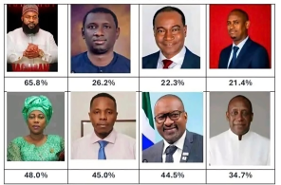
As Sierra Leone’s political heavyweights position themselves for the 2028 presidential election, a new report by the Institute for Governance Reform (IGR) is bringing renewed attention to the fierce internal contests for the presidential tickets of the governing Sierra Leone People’s Party (SLPP) and the opposition All People’s Congress (APC).
With both parties expected to hold decisive conventions to select their presidential candidates, the battle is no longer simply about public popularity, political connections or the size of campaign rallies. The critical question is whether aspirants enjoying public support can translate that popularity into votes from the delegates who will ultimately determine their parties’ flagbearers.
The October edition of IGR’s Sierra Leone’s Political Marathon examines this high-stakes political contest, drawing on a study involving 2,400 likely voters and the views of 1,025 randomly selected APC and SLPP delegates. The report combines a nationally representative survey of Sierra Leoneans aged 18 and above with responses from party delegates, offering two perspectives on the emerging flagbearer race.
Its central political question is difficult to ignore: Will the candidates celebrated by the public also command the loyalty of the delegates who hold the power to decide their parties’ presidential tickets?
THE DELEGATE FACTOR: WHERE POLITICAL DREAMS COULD COLLIDE WITH REALITY
For aspirants in both parties, the road to 2028 could be determined by a political constituency that often operates beyond the glare of public rallies and social media campaigns.
A candidate may attract enthusiastic crowds, dominate political discussions and enjoy considerable public recognition, yet still face a difficult contest inside the convention hall. The reason is simple: public opinion and delegate preferences are not necessarily the same.
In a flagbearer contest, delegates are not merely spectators. Their votes can determine who emerges as the party’s presidential candidate and who must abandon, postpone or reconsider their ambitions.
This creates a potentially uncomfortable reality for aspirants who mistake public applause for guaranteed support within their parties.
The IGR report’s inclusion of delegate perspectives is therefore significant because it provides an additional measure of the internal political dynamics that a general-population survey alone may not capture.
However, the findings must be examined carefully. The available figures on the survey sample do not, by themselves, establish which aspirant leads the race. That assessment requires the report’s candidate-by-candidate results, including the percentages recorded among delegates and the wider electorate.
BEHIND THE SMILES: THE QUESTION OF DELEGATE LOYALTY
One of the most sensitive issues surrounding party conventions is whether delegates will vote according to their publicly expressed preferences when the time comes to cast their ballots.
Political loyalties can be shaped by personal relationships, party structures, endorsements from influential figures, ideological considerations, campaign organisation and expectations about a candidate’s leadership.
There are also longstanding concerns about allegations of vote-buying and the influence of financial inducements in internal party contests. Such concerns, however, should not be confused with proof that particular aspirants or delegates have engaged in wrongdoing.
The challenge for pollsters is determining how accurately declared preferences reflect the decisions delegates will make when voting begins.
Some delegates may be reluctant to disclose their choices. Others may change their minds as alliances shift, endorsements emerge or candidates strengthen their positions within party structures.
Consequently, a survey represents a snapshot of preferences at a particular time—not a guarantee of the final convention outcome.
As the APC and SLPP contests progress, the relationship between public popularity and delegate support will remain a central issue in assessing the competing presidential ambitions.
APC AND SLPP: TWO PARTIES, ONE HIGH-STAKES QUESTION
Although the APC and SLPP have different political histories, internal structures and constituencies, both face the challenge of selecting candidates capable of securing their respective parties’ nominations ahead of 2028.
For the APC, the flagbearer contest will be a defining moment in determining who carries the party’s presidential ambitions into the next general election.
For the SLPP, the process will similarly shape the party’s choice of candidate and its preparations for the 2028 electoral contest.
In both cases, the conventions will test the organisational strength of aspirants, the durability of their alliances and the extent to which their support extends beyond public visibility.
The IGR survey offers an opportunity to examine these dynamics through the responses of both ordinary voters and party delegates. But without the detailed candidate rankings and percentages, it would be premature to declare a frontrunner or suggest that any aspirant has secured the support necessary to win a party convention.
THE POLITICAL MARATHON IS FAR FROM OVER
The October report arrives at a time when political calculations surrounding 2028 are becoming increasingly important. Yet the distance between a survey response and a convention victory can be considerable.
Campaigns will evolve. Alliances may change. Party leaders and influential figures may endorse particular aspirants, while delegates may reassess their preferences as the conventions approach.
The decisive question is not simply who attracts the loudest cheers today, but how faithfully current survey findings reflect the preferences that will eventually be expressed through the ballot.
For journalists, party members and citizens following the contest, the report provides a framework for examining the relationship between national popularity and internal party support. Its significance will depend on the detailed findings, the methodology used and how the results compare across the two groups surveyed.
One political reality remains clear: in a delegate-driven convention, public enthusiasm and convention votes are two different measures of support.
As the APC and SLPP prepare for their respective battles, the real test will be whether the aspirations expressed in public can withstand the private calculations, shifting alliances and final decisions that shape a party’s choice of presidential candidate.
A WISE SAYING: DELEGATES AND POLITICIANS
“A politician’s biggest mistake is confusing a delegate’s applause with allegiance.”