

Sierra Leone Heightens Ebola Vigilance After Kenya Confirms Imported Case

By Staff Writer
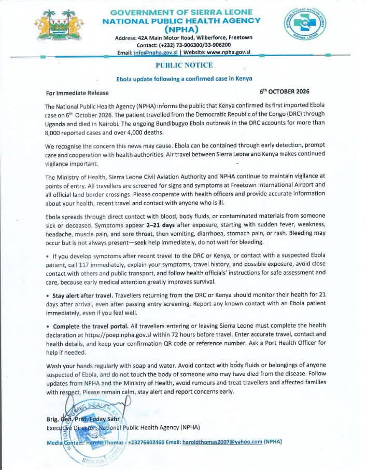
The National Public Health Agency (NPHA) has heightened public health vigilance in Sierra Leone following confirmation by Kenya of its first imported Ebola case on 6 October 2026.
According to the NPHA, the patient had travelled from the Democratic Republic of Congo (DRC) through Uganda before arriving in Nairobi, where the patient subsequently died.
The agency said the development requires continued vigilance, particularly because of air travel links between Sierra Leone and Kenya.
The NPHA said the ongoing Bundibugyo Ebola outbreak in the DRC has reportedly recorded more than 8,000 cases and over 4,000 deaths.
While acknowledging the concerns the development may cause, health authorities stressed that Ebola can be contained through early detection, prompt medical care and close cooperation with public health officials.
The Ministry of Health, Sierra Leone Civil Aviation Authority and the NPHA are maintaining enhanced vigilance at points of entry across the country.
Travellers arriving in Sierra Leone are being screened for signs and symptoms at Freetown International Airport and official land border crossings.
The NPHA has urged travellers to cooperate with health officers and provide accurate information regarding their health status, recent travel history and possible contact with anyone who may be ill.
Ebola is transmitted through direct contact with the blood, body fluids or contaminated materials of an infected person or someone who has died from the disease.
Symptoms can appear between 2 and 21 days after exposure and may initially include sudden fever, weakness, headache, muscle pain and sore throat. Other symptoms can include vomiting, diarrhoea, stomach pain and rash.
The NPHA warned that bleeding may occur but is not always present, urging anyone who develops symptoms not to wait for bleeding before seeking medical attention.
People who develop symptoms after recent travel to the DRC or Kenya, or after possible contact with a suspected Ebola patient, have been advised to immediately call 117, provide details of their symptoms, travel history and possible exposure, avoid close contact with others and refrain from using public transport while awaiting instructions from health officials.
The agency said early medical attention can significantly improve the chances of survival.
Travellers returning from the DRC or Kenya have also been advised to monitor their health for 21 days after arrival, even if they passed health screening at the point of entry.
The NPHA further urged anyone who knows they have had contact with an Ebola patient to report the exposure immediately, even if they are not experiencing symptoms.
As part of continued disease surveillance, all travellers entering or leaving Sierra Leone are required to complete the health declaration through the NPHA travel portal at poep.npha.gov.sl within 72 hours before travel.
Travellers have been advised to provide accurate travel, contact and health information and retain their confirmation QR code or reference number. Port Health Officers are available to assist travellers who require help completing the declaration.
The public has also been urged to practise regular handwashing with soap and water, avoid contact with the body fluids or personal belongings of anyone suspected of having Ebola, and never touch the body of someone who may have died from the disease.
The NPHA called on the public to rely on official updates from the health authorities, avoid spreading rumours and treat travellers and affected families with respect.
The agency urged the public to remain calm, stay alert and report concerns early as Sierra Leone continues to strengthen surveillance and preparedness measures.