
Presidential Security Bombshell: How Did Wanted Drug Fugitive Get Inside Bio’s Inner Circle?

By Kelvin Jay
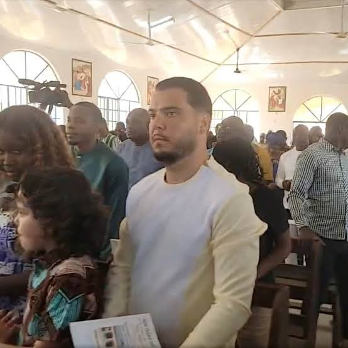
A major security and protocol controversy is unfolding over the reported appearance of wanted Dutch drug fugitive Jos Leijdekkers, popularly known as “Bolle Jos,” at a Church service in Tihun on New Year’s Eve, where he was reportedly seen within close proximity to President Julius Maada Bio and members of the presidential delegation.
The reported incident has raised a fundamental question that the authorities have yet to fully answer:
How did an internationally wanted fugitive gain access to a presidential event and apparently move within the President’s official entourage?
The issue goes far beyond the presence of one individual at a church service. It has opened a broader debate about presidential security, access control, protocol, intelligence gathering and the procedures used to identify and vet individuals who come into close contact with the Head of State.
WHO CLEARED BOLLE JOS?
The State House Protocol Unit plays a critical role in coordinating presidential engagements, including liaison with event hosts, delegation arrangements, accreditation, seating, order of precedence and the overall organization of presidential programmes.
However, responsibility for determining who accompanies the President may extend beyond protocol alone, involving the President, Chief of Staff, security personnel and other relevant officials.
During AYV’s State of the Nation programme, host Umaru Fofana put the question directly to Chief Minister David Moinina Sengeh: how was Leijdekkers able to gain access to the church in Tihun and reportedly appear among the President’s delegation?
The Chief Minister said he had no knowledge of how the fugitive gained access.
That response, rather than closing the matter, raises an even bigger question:
If the Chief Minister did not know, who did?
Who compiled the list of people around the President? Who checked their identities? Who controlled access to the presidential delegation? And who, if anyone, cleared Leijdekkers to be in that environment?
The questions become even more serious if the photographs and video footage circulating from the event accurately depict Leijdekkers sitting in close proximity to President Bio and members of his family.
Was he invited?
Was he part of another delegation?
Was he introduced to anyone within the presidential entourage?
Or did he simply find his way into an area where access should have been tightly controlled?
A SECURITY LAPSE THAT DEMANDS EXPLANATION
The presence of the alleged drug fugitive has been defended by several people. Some argue that the church is an open place and that anyone can attend a religious service. Others, however, contend that an unidentified individual sitting within or around the President’s delegation raises a completely different security concern.
And therein lies the dilemma.
The issue is not simply whether Leijdekkers had the right to enter a church. The more important question is how he was able to gain access to the President’s immediate vicinity and reportedly sit within the delegation area.
Presidential security is not simply about protecting the physical safety of the Head of State. It also involves knowing who is in the President’s immediate environment, why they are there and how they gained access.
If an internationally wanted individual was able to enter a presidential gathering without being identified, that would raise serious questions about the effectiveness of the country’s security and vetting mechanisms.
And if officials knew his identity but nevertheless allowed him to remain within the presidential environment, the questions become even more profound.
THE LOR RESTAURANT FOOTAGE: WHAT HAPPENED?
The Tihun controversy is further complicated by video footage reportedly showing former Immigration officer Alusine Kanneh and Andrew Kaikai at Lor Restaurant in the company of Leijdekkers.
The footage allegedly shows Leijdekkers handing gifts to the former immigration official, reportedly in the presence of a former senior anti-drug enforcement official.
If the individuals in the footage are indeed the persons identified, and the circumstances depicted are authentic, the public is entitled to ask what happened afterwards.
Did the Government investigate the encounter?
Were those involved questioned?
Were the alleged gifts identified and their purpose established?
Was any connection between the meeting and Leijdekkers’ alleged activities investigated?
Most importantly, did the authorities launch any formal inquiry after the footage became public?
These questions cannot simply be brushed aside, particularly when the individuals reportedly involved include people with previous responsibilities in immigration and anti-drug enforcement.
WHERE WAS THE SECURITY NET?
The controversy raises a number of questions that demand answers from the authorities:
• Who prepared and approved the President’s delegation for the Tihun church service?
• Was Jos Leijdekkers formally invited or listed as part of the delegation?
• Who was responsible for identifying and vetting individuals around the President?
• Were State House protocol and security officials aware of his presence?
• How did he gain access to the area occupied by the President and his entourage?
• When did authorities first establish or suspect his identity?
• Was an internal investigation launched?
• Were any protocol, security or other officials questioned over the incident?
• What measures, if any, have since been introduced to prevent a recurrence?
These are legitimate public-interest questions, not merely political speculation.
THE DUTCH CONNECTION
The controversy comes at a time when the Dutch Government continues to insist that Leijdekkers has been hiding in Sierra Leone and has sought his extradition.
Dutch authorities consider him a major drug-trafficking suspect and have repeatedly expressed concern over his alleged presence in the country.
The Sierra Leone Government, on the other hand, has rejected claims that Leijdekkers is currently in the country.
That conflicting position makes the Tihun incident even more significant.
If the man seen in the footage is indeed Jos Leijdekkers, then the Government faces an obvious question:
How could a person it says is not in the country appear at an event involving the President of the Republic?
SIERRA LEONEANS DESERVE ANSWERS
At the heart of this controversy is one simple but troubling question:
How did a man wanted internationally on serious drug-trafficking allegations get close enough to the President to reportedly appear within his delegation?
The Government may ultimately have a perfectly reasonable explanation. But that explanation must be provided.
If Leijdekkers was not officially part of the delegation, the authorities should explain how he gained access, who facilitated or enabled that access, whether officials knew who he was and what action was taken once his identity became known.
The reported meetings involving former immigration and anti-drug enforcement officials also deserve proper scrutiny if the identities and footage are verified.
This is not simply about politics. It is about presidential security, national reputation, immigration controls, the fight against narcotics and the integrity of Sierra Leone’s institutions.
The public therefore deserves clarity.
Who opened the door for Bolle Jos—and why was nobody watching?