
EU Marks 50 Years of Partnership and Development Support to Sierra Leone

By S.B. Amara
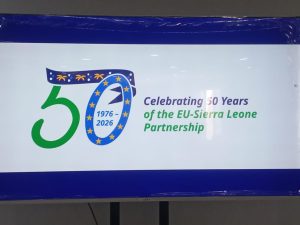
The European Union (EU) has commemorated 50 years of partnership and cooperation with Sierra Leone, highlighting decades of support in democratic governance, infrastructure, education, healthcare, agriculture, peacebuilding, and sustainable development.
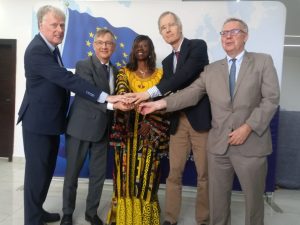
Speaking during the celebration in Freetown, the EU Ambassador to Sierra Leone, Jacek Jankowski, described the EU-Sierra Leone relationship as a strong and enduring partnership that has evolved significantly since the establishment of the EU Delegation in Freetown in 1976.
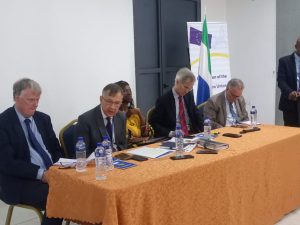
He said the EU has invested European taxpayers’ resources to support Sierra Leone’s development aspirations and strengthen peace, democracy, human rights, and economic growth.
“We have shared a remarkable five decades of cooperation, delivering profound benefits for the people of Europe and Sierra Leone,” Ambassador Jankowski stated. “Today, the European Union is widely recognized as a credible and reliable partner committed to supporting the prosperity of Sierra Leone and its people.”
According to him, over the past five decades, the EU has worked closely with successive governments, civil society organisations, political parties, the media, and citizens to promote peace, stability, democratic governance, gender equality, and sustainable socio-economic development.
He noted that EU development support remains aligned with Sierra Leone’s national development priorities, including the Government’s Medium-Term National Development Plan and the “Big Five Game Changers” agenda.
Ambassador Jankowski disclosed that since 1976, the EU has committed more than €1.7 billion in grants and budgetary support to Sierra Leone. He added that under the 2021–2027 Multiannual Financial Framework, the EU has allocated €352 million to strengthen democratic institutions, promote a green economy, protect biodiversity, and improve education.
He highlighted major achievements, including the construction and rehabilitation of more than 355 kilometres of major roads, representing about 85 percent of Sierra Leone’s primary regional transport network along the strategic Praia-Dakar-Abidjan coastal corridor.
The Ambassador further revealed that the EU has invested over €150 million in Sierra Leone’s health sector since 1976 and provided emergency support during national crises, including €47 million during the 2014 Ebola outbreak and €15 million to support the country’s COVID-19 response.
On democratic governance, he said the EU has deployed five Election Observation Missions to Sierra Leone, making the country one of the top African nations to benefit from such support alongside Nigeria and Kenya.
“We strongly believe that the will of the people should be reflected in the official results of elections,” he emphasized.
Reflecting on the evolution of the partnership, Ambassador Jankowski explained that cooperation initially focused on humanitarian assistance, peacebuilding, and reconstruction, particularly during the post-independence and post-war periods. He said the partnership later transitioned under the Cotonou and Samoa Agreements, with greater emphasis on mutual interests, human rights, and the rule of law.
He also praised the Sierra Leone Government’s commitment to political dialogue with the EU, noting that annual partnership discussions are chaired by President Julius Maada Bio, demonstrating the importance of EU-Sierra Leone relations.
The Ambassador described the European Union as a “great project” strengthened by the collective contributions of its member states, including Germany, Ireland, and France.
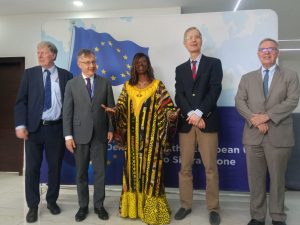
Meanwhile, German Ambassador to Sierra Leone, Pascal Richter, said Germany’s bilateral cooperation with Sierra Leone dates back to 1961, the year of the country’s independence.
He described Sierra Leone as a valued partner and highlighted Germany’s continued support in energy, health, agriculture, education, environmental protection, and infrastructure development.
Dr. Richter revealed that Germany and Sierra Leone recently concluded governmental negotiations resulting in three major new projects, particularly in the energy sector.
He also disclosed that Germany has supported the rehabilitation of about 300 kilometres of feeder roads and the construction of 30 bridges, while contributing significantly to reducing maternal mortality in targeted districts.
The German Ambassador commended President Bio’s regional leadership role as Chairman of ECOWAS, stressing the importance of peace, regional stability, and diplomatic engagement within West Africa.
For his part, Irish Ambassador to Sierra Leone, Patrick McManus, reaffirmed Ireland’s commitment to promoting human rights, democracy, inclusion, dignity, and protection for vulnerable groups.
He said Ireland continues to work closely with the EU Delegation and other European partners in supporting Sierra Leone’s Medium-Term National Development Plan, particularly in food security, nutrition, education, gender equality, and governance.
Ambassador McManus further noted that Ireland supports the EU’s broader agenda on competitiveness, rule of law, and democratic governance.
Also speaking, French Chargé d’Affaires, Jean Lamy, underscored France’s longstanding commitment to Sierra Leone, including the reopening of the French Embassy in Freetown.
He said France’s development assistance aligns with the United Nations Sustainable Development Goals, focusing on peace, people, partnership, and progress, with ongoing projects in the energy and agriculture sectors.
Representing the Government of Sierra Leone, Minister of Planning and Economic Development, Kenyeh Barlay, expressed appreciation for the EU’s longstanding support and solidarity with Sierra Leone.
The Minister stated that the partnership has contributed immensely to progress in agriculture, education, renewable energy, governance, and infrastructure development.
She emphasised the importance of sustained cooperation and increased visibility of development programmes to ensure that citizens fully appreciate the impact of EU-supported initiatives across the country.